
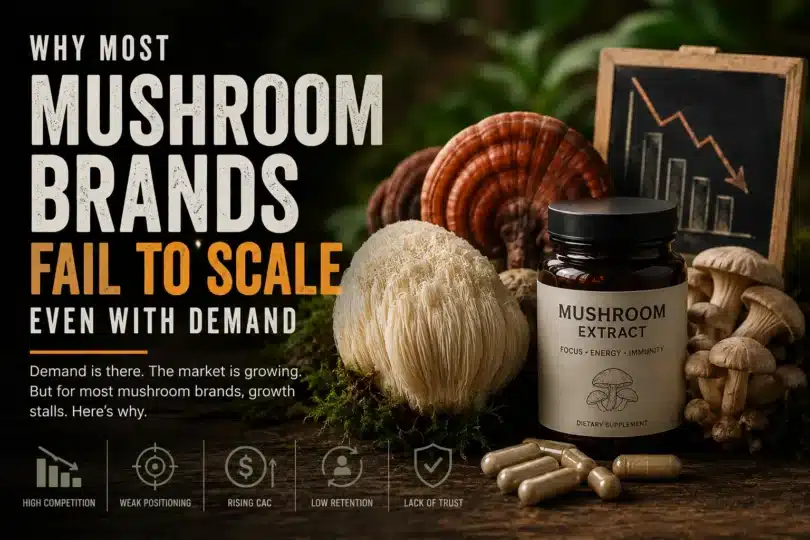

Why do so many mushroom brands scale poorly or fail to scale at all?
Demand for functional mushrooms is not the problem. The market is booming. Consumer interest continues to grow, awareness is higher than ever, and products built around ingredients such as lion’s mane, cordyceps, reishi, turkey tail, and chaga are becoming increasingly common on retail shelves and online marketplaces. On the surface, this should be one of the easier wellness categories to build a business in.
So why do so many mushroom brands struggle to scale?
At first glance, there is no obvious reason. Search volume remains strong, new products enter the market every month, and industry forecasts continue to project long-term growth. On the surface, functional mushrooms should be one of the easier wellness categories in which to build a successful business.
Yet many brands follow the same pattern. They launch, gain initial traction, generate sales, and then hit a wall. Growth slows, customer acquisition becomes more expensive, repeat purchase rates fail to improve, and margins come under pressure. Eventually, the business reaches a point where scaling becomes far more difficult than expected.
There is clearly a hidden bottleneck somewhere. Identifying it is the key to finding out why some mushroom brands continue to grow while others remain stuck. Let’s take a closer look.
Why Most Mushroom Brands Fail to Scale
To answer the question ‘Can Mushroom Brands Scale?’ we need to look at a typical founder’s journey.
Many mushroom brands launch successfully and generate early momentum. For a while, everything appears to be moving in the right direction. Consumers are interested, orders begin to arrive, and the future looks promising. Then growth starts to slow. Customer acquisition becomes more expensive, repeat purchases fail to increase, and founders find themselves working harder for every additional sale.
This happens so frequently that it can no longer be explained by competition alone. Many founders assume that because consumer interest in functional mushrooms continues to increase, mushroom brands can scale simply by participating in a growing market. Unfortunately, that is not how the market works and while the functional mushroom market may be expanding rapidly, that growth is not distributed evenly across every company operating within it.
Consumers are not simply buying reishi, lion’s mane, cordyceps, or other mushroom products. They are buying specific brands. Brands they know, trust and in many cases, already bought from. A relatively small number of established brands continue to capture a disproportionate share of consumer attention, trust, and repeat purchases. Companies that invested early in positioning, education, and brand building benefit from years of accumulated credibility, while newer competitors often find themselves fighting for the remaining share of the market.
So yes, some mushroom brands scale, but most do not. The mushroom brands that scale consistently are often solving a completely different set of challenges than the brands that remain stuck. They are not relying on demand alone. They have built stronger positioning, clearer messaging, better retention systems, and greater customer trust. And this is why they are winning the market, while others struggle to grow.
Can Mushroom Brands Scale? The Commodity Trap
At the product level, many mushroom supplements look remarkably similar. Most brands source comparable ingredients, rely on similar extraction methods, and manufacture products using nearly identical processes. From a consumer’s perspective, one lion’s mane capsule often appears very similar to another. The same applies to cordyceps, reishi, and many other popular ingredients.
When products become difficult to distinguish, competition naturally shifts elsewhere.
Brands begin competing on price. Packaging becomes increasingly important. Marketing claims become more aggressive. Companies search for visible ways to stand out because the product itself no longer provides enough differentiation.
This is where many businesses begin creating long-term problems for themselves. Price competition reduces margins. Packaging can be copied. Marketing claims often become exaggerated. And since everyone is using the same strategy, they all lose: customer acquisition costs rise, loyalty declines, and the business becomes increasingly dependent on promotions and discounts to maintain momentum.
Unfortunately, many founders can’t identify the root of their problems and believe they have a ‘marketing problem’ when, in reality, they simply have poor positioning.
Positioning Is Usually the Real Bottleneck
The strongest mushroom brands rarely win because they have the best ingredients. They win because they have the clearest positioning.
On the other side, we find many generic brands with poor positioning trying to fix their problems with more advertising, increased traffic, new products, or expanded distribution. While it helps for a while, as the real bottleneck sits at the very core of the business, all gains are short-term.
Unless you fix your positioning, your brand is going to get stuck again and again. Positioning determines how customers perceive your brand, why they choose you over competitors, and what specific problem they believe you can help them solve. When positioning is weak, every marketing activity becomes less effective. When positioning is strong, customer acquisition becomes easier, conversion rates improve, and retention often follows.
Inshort, fixing your positioning is your first step to become profitable and successful.
Jack of All Trades, Master of None
Unfortunately, positioning remains one of the weakest areas across the functional mushroom industry. Many mushroom brands attempt to appeal to everyone by promoting every possible benefit at once. Some products claim to support focus, energy, immunity, stress management, longevity, recovery, performance, sleep, and overall wellness. Now imagine what a consumer thinks when reading that list of claims.
Consumers rarely buy because a product offers ten different benefits. They buy because they believe it can help them achieve one meaningful outcome. The clearer that outcome becomes, the easier it is to understand why they should buy. This is positioning.
This is where many mushroom brands make a critical mistake. Instead of owning a specific position in the customer’s mind, they attempt to occupy many positions at the same time. When customers land on a website and immediately see many different claims they become skeptical. Rather than making the product appear more valuable, the poor positioning is driving people away.
The old saying, “Jack of all trades, master of none,” perfectly describes what happens to many mushroom brands. In their effort to appeal to everyone, they end up standing for nothing specific. Yes, people may buy once after seeing a 50% discount coupon, but no one will return unless this coupon remains forever, unless something unique happened to them, and their problem was solved.
Why Acquisition Gets More Expensive Over Time
Now let’s look ahead. The acquisition challenges facing mushroom brands are becoming more difficult every year and many of them may not survive. Health-related categories will see increasing restrictions across major advertising platforms. Brands will face more limitations around claims, targeting, and messaging, while consumers have already become skeptical of wellness marketing and are now very selective about the companies they trust.
Spending heavily on content marketing, influencer partnerships, affiliate relationships, community building, and marketplace visibility can help, but only if you do it right. These marketing channels can work extremely well, but they tend to scale more slowly and require stronger positioning than traditional performance marketing.
Without clear messaging and differentiation, acquisition costs will continue to rise and profitability will drop to the point you will have to shut their doors. Many founders are aware of that, so they try to improve and test new marketing channels, new products and new partnerships. Sometimes these changes help. But unless they fix their positioning you will always see more roadblocks coming their way.
Retention Starts With Expectations
Let’s look at retention to understand how a small change to your positioning, could create a massive positive impact on your brand.
The economics of supplements are heavily dependent on repeat purchases. A customer who buys once and never returns is rarely profitable over the long term. Sustainable growth requires customers to develop ongoing purchasing habits. This is where many mushroom brands encounter another challenge, as they just can’t convince their clients that their products are effective…
The benefits associated with ingredients such as lion’s mane, cordyceps, and reishi are often gradual and subtle. The experience can vary between individuals, and noticeable results may take time if they arrive at all. This creates a gap between expectation and reality.
This is where your aggressive marketing and unsupported claims are working against you. When customers purchase a product expecting dramatic results, even a well-formulated supplement will feel disappointing. A customer who expects lion’s mane to transform focus within a few days may stop using the product long before meaningful benefits have a chance to develop. And even if they continue using the product for a month, the results may not appear in the way they expected.
When we paint the product with brighter colors, we are not only creating more expectations, we are putting our brands to a test. Once we fail, we lose their trust, and this is something you should never do, at any cost.
If you are interested in creating a long-lasting brand, don’t try to grow too fast, but instead make sure you keep growing slowly. Don’t ever try to accelerate growth by making bold promises. While this approach may improve short-term conversions, it often damages long-term retention.
The mushroom brands that scale successfully typically take a different approach. They focus on education rather than hype. They explain what the product is designed to do, how it should be used, and what realistic expectations look like. Retention improves only when expectations and experience align.
Can Mushroom Brands Scale? Not Without Trust
As the mushroom market matures, trust is becoming one of the most powerful competitive advantages available.
Consumers are asking more sophisticated questions than they were a few years ago. They want to know where ingredients come from, how products are manufactured, whether extracts are properly standardized, and whether the label accurately reflects what is inside the bottle. They look for third-party testing, transparent sourcing, and accurate dosing information.
Not only do brands that provide clear answers to these questions gain an advantage, failure to do so will make you appear untrustworthy. In addition, trust is crucial to the purchasing process, improves conversion rates and strengthens retention. Without trust, every new customer must be convinced from the beginning. With trust, previous customers help validate the brand for future customers.
This is one reason many successful mushroom companies increasingly behave like educators rather than advertisers. They invest heavily in content, transparency, and market education because those activities strengthen trust over the long term and create a foundation that competitors cannot easily copy.
Most Brands Will Fail, Don’t Be Among Them
The functional mushroom industry continues to grow, and there is every reason to believe demand will remain strong for years to come. But growth is not distributed evenly across every company operating within it, so if you want to grow with the market, you need to adapt and do it fast.
The brands that recognize this early have an opportunity to build stronger foundations, improve retention, strengthen positioning, and create more resilient growth systems. That is how mushroom brands scale. The brands that build trust, improve positioning, and focus on retention are the ones most likely to win tomorrow.




Have anything to add? Your voice matters! Join the conversation and contribute your insights and ideas below.