
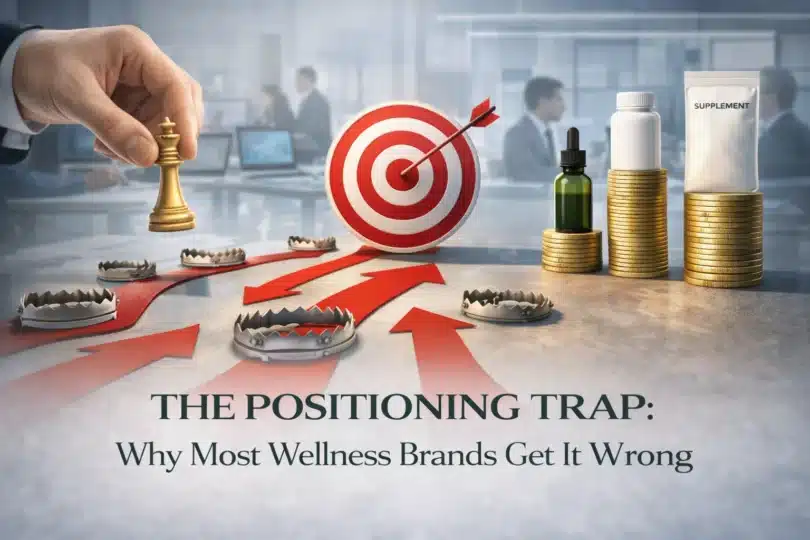

Wellness brand positioning starts with one question: what makes your brand unique.
Ask most wellness founders who they are and they’ll answer with their product instead. “We make a high-bioavailability magnesium supplement.” “We sell full-spectrum CBD oil, third-party tested.” “Our pet health line uses only organic, human-grade ingredients.”
All true. None of it is wellness brand positioning. In-fact, there are only a few companies that understand how important wellness brand positioning is.
Positioning isn’t what you make, it’s who you are or what is your solution to a specific problem. It’s the reason that makes the client choose you over other. And the brands that define themselves by their product almost always end up in the same place: competing on price, fighting for attention in a crowded category, wondering why growth has stalled.
In a category where everyone offer dreams and focus on high-quality, organic and natural ingredients your brand must stand out. The natural way is to drive attention to your products, but that’s what everyone does…
Wellness Brand Positioning – Can You Solve My Problem?
It feels natural to lead with the product. You’ve spent months or years developing it. You know every ingredient, every formulation decision, every quality control step. The product is real and specific in a way that “positioning” feels abstract.
But your buyer doesn’t start with your product. They start with a problem.
They’re not waking up thinking “I need a high-bioavailability magnesium supplement.” They’re waking up thinking “I can’t sleep” or “my stress levels are unsustainable” or “my dog’s joints are getting worse.” The product is a potential solution to a problem they already have. Whether they choose your product over the thirty others at the same shelf depends entirely on whether your brand speaks to that problem more clearly and credibly than the alternatives and whether they can trust YOU.
When you lead with the product, you’re answering a question your buyer hasn’t asked yet. When you lead with the problem, you’re meeting them where they already are. True, when you lead with a solution you might end up with claim you are not allowed to say, that’s why this step is so important: knowing how to support your claims in a way that won’t put you in risk. That is why smart brands are winning by turning regulations Into a competitive advantage, while others are trying to avoid it and fail.
That’s the difference between positioning that works and positioning that doesn’t.
Wellness Brand Positioning is Difficult
In an unregulated market, you can close the gap between product and problem with direct claims. “This will help you sleep.” “This reduces anxiety.” “This relieves joint pain.”, etc.
In regulated wellness, you can’t make those claims, or you can only make them within strict limits that make them feel vague and unconvincing. So the gap between product and problem stays open, and most brands fill it with the same generic language: “natural,” “effective,” “trusted,” “premium.”
The buyer reads those words and feels nothing. Because everyone says them. Because they can’t be proven. Because they address no specific problem the buyer actually has.
True, this constraint is frustrating. But it’s also, as I’ve written before, an opportunity. The brands that figure out how to speak to their buyer’s problem within their regulatory constraints, specifically, credibly, without overclaiming and focus on the truth.
The constraint forces creativity. Most brands fail because they don’t know how to solve this problem.
The Three Positioning Questions Most Brands Can’t Answer
If you’re not sure whether your positioning is working, try answering these three questions as specifically as possible.
Who is your buyer, exactly?
Not “health-conscious consumers.” Not “people interested in wellness.” The specific person, their age, their situation, their prior experience with products in your category, their level of skepticism, their information sources, what they’ve already tried and why it didn’t work.
The more precisely you can describe your audience, the more precisely your messaging can speak to it. Vague positioning attracts vague buyers. Specific positioning attracts the right buyers, the ones who stay, who repeat purchase, who tell others.
What problem are you solving, specifically?
Not the general category problem. The specific, particular, this-is-what-keeps-them-up-at-night problem. The one your product should be uniquely positioned to address. The one that, when you name it precisely, makes your buyer feel genuinely understood rather than marketed to.
In regulated wellness, you often can’t name the problem directly in your advertising. But many times you have ways to point to it in your content, your email, your community, your brand story. The channels that actually work in this market are the ones where you have the freedom to be specific, the brains to do it right and the balls to do it at all.
Why should they believe you over the alternatives?
This is the hardest question and the one most brands skip. “Because our product is better” isn’t an answer as every other brand says that. The real answer is specific and provable: your sourcing, your testing, your formulation rationale, your track record, your transparency about what you can and can’t claim and why.
Don’t offer 100 fraudulent reviews, that will only put you in trouble. Try to do the hard work, with real science and treat your brand like a pharmaceutical one, with that level of seriousness.
If you can’t be specific and verifiable about your brand and about your solutions, your buyer doesn’t have any real reason to choose you. Practice on your elevator pitch – that 30-to-60-second, concise professional summary designed to introduce who you are, what you do, and your unique value is. Until you do it right, your path to success is blocked.
What Good Wellness Positioning Actually Looks Like
Good wellness brand positioning has three qualities.
It’s specific enough to exclude people. If your positioning speaks to everyone in your category, it speaks to no one… The best-positioned brands in this market have a clear sense of who they’re for and who they’re not for, and they’re comfortable with that.
It’s built around a specific buyer’s problem, not the product’s features. Features are the proof (and make sure your deliver the truth in every statement of your brand, or you will lose trust). The problem is the hook, always. Lead with what keeps your buyer awake, and use your method, research, tests and features to explain why you’re the solution.
It works within your regulatory constraints rather than despite them. The positioning doesn’t depend on claims you can’t make. It’s built on what you can prove, what you can demonstrate, what your buyer can verify independently. That kind of positioning is durable in a way that claim-dependent positioning never is.
Where to Start
Sadly, repositioning an existing brand is harder than positioning a new one. But the starting point for a successful wellness brand positioning is the same: get out of your own product and into your buyer’s specific problems.
Talk to your customers. Not a survey, not reviews, not AI, but a real conversation and do it often! Ask them what they were trying to solve when they found you. Ask them what they’d say to a friend who had the same problem. Ask them what made them choose you over the alternatives. The language they use to answer those questions is almost always better positioning material than anything your marketing team has written.
Then look at that language and ask: does our current messaging reflect this? Does someone who arrives at our website with the problems our customers had would feel immediately understood.
If the answer is no, and for most regulated wellness brands, it is, that’s where the work starts.
Not in marketing. Not in advertising. Not in a new marketing channel. In the positioning that everything else is built on. This is where you should focus your attention, as nothing else will help, if your brand uniqueness is the color of your packaging…




Have anything to add? Your voice matters! Join the conversation and contribute your insights and ideas below.