
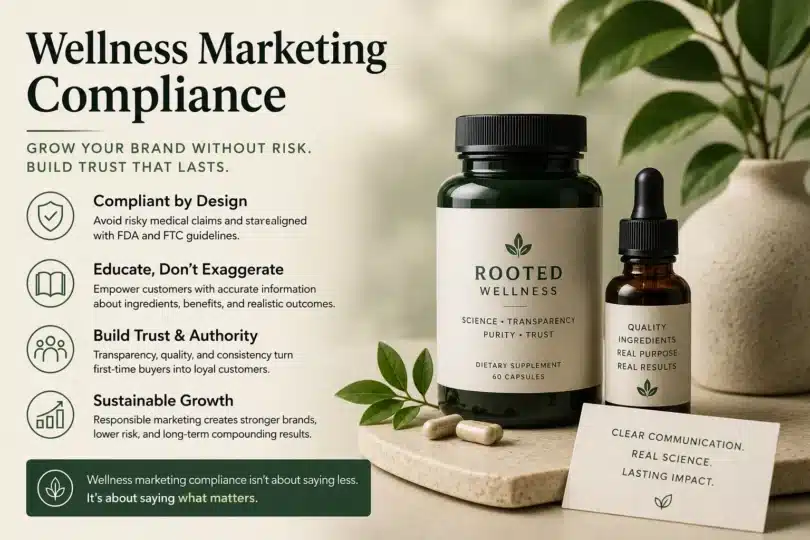

One of the biggest mistakes wellness brands make is believing they need aggressive claims in order to grow. In reality, wellness marketing compliance is becoming one of the most important factors behind sustainable long-term growth in regulated wellness markets. The key is knowing how to use compliance to your advantage, which means understanding what to do, how to communicate properly, and what you should never do.
The problem begins with a misunderstanding of how wellness marketing actually works.
Founders often assume stronger promises create stronger sales. The market reinforces this constantly. Competitors make exaggerated claims, influencers push unrealistic expectations, and social media rewards dramatic messaging over careful communication.
In practice, this assumption is often wrong.
Why Louder is Not Better
At first glance, it can feel like the loudest brands win. But in regulated wellness marketing, that strategy is self-defeating and usually creates long-term problems.
True, aggressive medical claims may generate short-term attention, but they also increase legal risk, platform restrictions, customer skepticism, and trust issues. Instead of lowering acquisition costs over time, brands often see CAC (Customer Acquisition Cost) rising while LTV (Lifetime Value) drops.
Your goal is always to increase the lifetime value of your customers, which means you earn more from each of them. You also need to keep an eye on your customer acquisition cost, as if CAC is greater or even equal to your LTV, you have a big problem…
If you see CAC rising and LTV dropping, you need to stop and address the problem immediately. Otherwise, your entire growth system can begin to break down. While this is an industry-wide problem, the way out of this trap is to improve your positioning, and avoid shouting yourself to death.
In wellness marketing, louder is almost always not better. The opposite.
Why Wellness Brands Become Obsessed With Medical Claims
The wellness industry is highly competitive. Most categories are crowded with companies trying to stand out while selling products that often appear similar on the surface.
As competition increases, many founders begin searching for stronger ways to differentiate themselves. This usually pushes brands toward increasingly aggressive promises, stronger emotional language, and unrealistic marketing claims.
Part of the problem comes from modern marketing culture itself.
Many founders are taught that growth comes from bigger promises, stronger hooks, emotional urgency, and aggressive conversion tactics. That logic may work in some industries, but regulated wellness marketing operates differently. In the wellness industry, the standard marketing tactics usually fail, and this is a hard lesson to learn.
Products connected to health, cognition, sleep, longevity, stress, or physical wellbeing exist inside a completely different trust environment. Customers are naturally more cautious, more skeptical, and more sensitive to exaggerated messaging.
The more aggressive the claims become, the more consumers begin questioning the credibility of the brand itself, and that is often the first step toward a breakdown in growth performance.
The Real Cost of Aggressive Claims
Many wellness founders focus only on the potential upside of aggressive claims. Very few properly calculate the downside.
Yes, medical claims can trigger FDA warning letters, advertising restrictions, marketplace removals, payment processor issues, or account suspensions.
But the long-term branding damage is often even worse.
When customers feel manipulated, disappointed, or misled, trust becomes extremely difficult to rebuild. This is especially dangerous in wellness because trust is not simply part of the marketing system; it is part of the product experience itself and essential to long-term success.
Customers want to believe wellness brands are responsible, transparent, and realistic about what their products can and cannot do. The moment a company starts sounding exaggerated, trust begins eroding.
Once skepticism appears, conversion becomes harder, retention weakens, and Customer Acquisition Costs (CAC) usually rise.
Customers Are More Skeptical Than Ever
What was easy 10 years ago has become almost impossible today. Over the past decade, consumers have been exposed to endless cycles of miracle products, influencer hype, exaggerated supplement claims, and misleading wellness advertising.
As a result, skepticism across the wellness market has increased dramatically.
Today, many consumers actively investigate brands before purchasing. They compare ingredients, read educational content, search for reviews, check third-party testing, and evaluate whether the company itself feels trustworthy.
Customers are not simply buying products; they are evaluating credibility. To sell to them, you must first earn their trust.
What Actually Builds Trust
The strongest wellness brands rarely rely on exaggerated claims.
Instead, they focus on helping customers better understand ingredients, formulations, manufacturing standards, realistic expectations, and product philosophy. They provide education first and only then suggest solutions.
This approach may feel slower than aggressive direct-response advertising, but it creates much stronger long-term foundations. When customers feel educated instead of manipulated, trust improves. Hesitation decreases. Retention strengthens. Authority compounds over time.
That process creates healthier and more resilient growth systems.
Education Converts Better Than Hype
One of the biggest misconceptions in regulated wellness marketing is that educational content converts poorly. In reality, education often performs better long term because it reduces uncertainty.
Customers who properly understand what a product is, how it was formulated, what realistic expectations look like, and why the company made certain decisions usually make better purchasing decisions. They are also far more likely to trust the brand, return later, recommend products, and remain long-term customers.
This is one reason many successful wellness companies increasingly operate more like educators and publishers than aggressive advertisers.
How Smart Wellness Brands Communicate Without Claims
Growing without medical claims does not mean becoming vague or weak. It means learning how to communicate responsibly and intelligently.
As we mentioned earlier, the strongest wellness brands usually focus on clarity, transparency, education, formulation quality, customer understanding, and realistic communication. They understand that responsible communication itself can become their competitive advantage.
Final Thoughts
Many wellness founders believe aggressive claims are necessary because they think customers only respond to stronger promises. But modern consumers are becoming increasingly skeptical of exaggerated wellness marketing.
In regulated wellness marketing, trust has become one of the most valuable assets a brand can build. The companies that survive long term are usually the ones that learn how to communicate clearly, responsibly, and credibly without depending on risky medical claims.
If you want to succeed in this industry, you should do the same.




Have anything to add? Your voice matters! Join the conversation and contribute your insights and ideas below.