
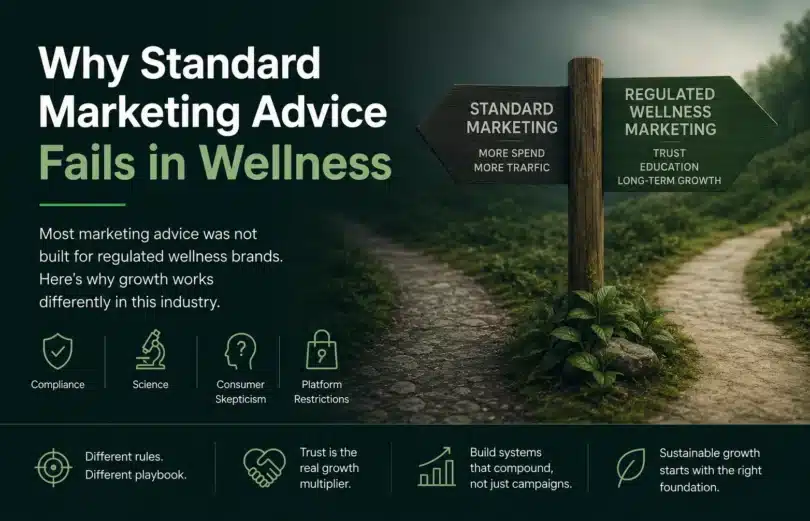

Most wellness brands are not failing because they lack marketing activity. They are failing because they apply systems built for completely different industries, without understanding that regulated wellness marketing operates under very different rules.
Over the past decade, the wellness market has become crowded with brands following nearly identical playbooks. Founders are told to increase ad spend, optimize conversion rates, scale influencer campaigns, push aggressive offers, produce more content, and automate funnels.
Some of those tactics can help temporarily. Very few create durable growth. What works in other industries is often poorly suited for regulated wellness marketing.
What Makes Regulated Wellness Marketing Different
Most mainstream marketing advice was designed for categories that operate with fewer restrictions, lower skepticism, and shorter trust cycles. Regulated wellness marketing does not work that way.
Supplement companies, functional mushroom brands, CBD businesses, longevity products, pet wellness companies, and adjacent categories operate inside an environment where trust matters more, compliance limits communication, and customer hesitation is significantly higher.
That changes everything.
A wellness customer is rarely buying a simple impulse product. They usually arrive with a specific problem and are searching for a solution. Because these products are also connected to areas like stress, sleep, cognition, aging, physical health, or long-term wellness, the decision-making process tends to be slower and more careful.
Customers research more extensively. They compare products more critically. And they expect a much higher level of credibility before trusting a brand.
Yet many wellness companies still rely on growth systems borrowed from fashion ecommerce, software startups, or generic direct-to-consumer brands. When those systems fail, founders often become frustrated because they believe they were doing “all the right things.”
In reality, many of those strategies were never designed to be used in regulated wellness markets in the first place.
Regulated Wellness Marketing Operates Under Different Rules
Most marketing strategies are built around businesses being able to communicate aggressively, or at least freely. A typical ecommerce company can often make bold claims, create highly emotional advertising, optimize heavily around conversion psychology, and scale rapidly through paid acquisition.
Regulated wellness marketing operates under very different conditions.
Messaging has to navigate FDA and FTC considerations. Advertising platforms frequently restrict or flag wellness-related language. Scientific nuance matters. Consumers are increasingly skeptical of exaggerated claims. Payment processors and marketplaces may suddenly decide to remove or restrict products. Even educational content requires careful thinking, because the way information is presented matters.
In-short, regulated wellness marketing follows a separate set of rules from the ones most founders learn through mainstream marketing advice.
But it does not end there.
Many founders misunderstand their situation and treat slowing performance as a tactical problem. As a result, they assume they need better ads, stronger creatives, more traffic, or larger marketing budgets. In most cases, those changes do not solve the underlying issue.
In fact, trying to force aggressive marketing methods into wellness often creates even bigger problems. Brands either spend more money without seeing meaningful results, or they begin using messaging that damages credibility and weakens customer trust, which is far more dangerous in the long run.
The Industry Has a Trust Problem
Trust is one of the most underestimated forces in wellness marketing.
In many industries, consumers buy based on convenience, price, aesthetics, or entertainment value. In wellness, customers usually want reassurance before they purchase. They want confidence that a product is legitimate, responsibly formulated, properly manufactured, and realistically presented. In short, they are looking for brands that feel credible and responsible, not companies making empty promises.
That trust has become much harder to earn.
Over the years, the wellness industry has developed a credibility problem. Consumers have seen exaggerated health claims, “miracle products,” influencer hype cycles, misleading formulations, and aggressive advertising promising unrealistic outcomes. As a result, skepticism across many wellness categories has increased significantly.
Today, many buyers approach wellness products cautiously.
This is especially visible in supplements, functional mushrooms, cognitive wellness, CBD products, longevity, and pet health. Consumers increasingly investigate brands before purchasing. They compare ingredients, search for third-party validation, read educational content, evaluate reviews, and decide whether the company itself feels trustworthy.
Social proof also plays a major role. Customers want reassurance that other people had positive, realistic experiences with a product before they commit to buying it themselves.
This creates a market where authority matters more than attention.
Many wellness brands respond to slowing growth by increasing ad spend, pushing harder promotions, or trying more aggressive marketing tactics. But in regulated wellness, trust is often the real bottleneck.
Before investing more money into advertising, brands usually need to fix deeper problems involving positioning, messaging, credibility, and customer trust.
Most Wellness Brands Sound Identical
One of the clearest signs of structural weakness in the industry is how similar wellness marketing has become.
Visit enough supplement websites and the language quickly starts blending together. Everything is:
- science-backed,
- premium,
- carefully formulated,
- natural,
- transparent,
- wellness-focused,
- or supported by experts.
None of these phrases are wrong. But nearly every brand uses them.
Over time, positioning becomes diluted. Customers stop recognizing meaningful differences between companies, especially when regulations prevent brands from communicating more directly about outcomes. Slowly, all brands begin sounding “the same”, and that is fatal for branding.
This pushes many businesses into increasingly unstable growth tactics.
Without strong positioning, brands become heavily dependent on temporary acquisition channels such as paid ads, influencers, discounts, affiliates, trend cycles, or marketplace visibility. Those systems may generate revenue for periods of time, but eventually most of them break.
Advertising costs rise, competition increases, customers become less responsive and brands copy each other. And when your positioning is weak, there is very little protecting your brand long term.
The solution is understanding that you are not simply competing on products. You are competing on credibility, clarity, trust, and positioning.
In regulated wellness, stronger branding usually creates better long-term results than simply spending more money on advertising.
Paid Advertising Has Become Increasingly Fragile
For years, paid advertising acted as the default answer for ecommerce growth. In wellness, this is not a reliable solution.
Advertising costs continue rising across many categories. Platform enforcement changes constantly. Approved messaging one month may become restricted the next. Accounts can face limitations with little warning. Certain ingredients or phrases may trigger reviews or reduced distribution. At the same time, competition has intensified dramatically.
This creates a dangerous dependency cycle.
Brands spend more money acquiring traffic while simultaneously operating inside categories where trust requires more time to build. Conversion becomes harder. Margins compress. Customer Acquisition Costs (CAC) rise.
Many founders respond by spending more on advertising. But in regulated wellness marketing, this strategy is self-defeating and often creates the opposite effect.
But it does not end here.
Aggressive marketing also causes consumers to become more skeptical, which increases Customer Acquisition Costs (CAC) even further.
The solution is to invest in assets you control, such as educational content, newsletters, organic search, communities, retention systems, and clear positioning. True, these assets usually grow more slowly than paid campaigns, but they are also much more resilient.
Stop chasing the ‘fast gain’ and start building the strategic assets that give your brand a permanent competitive advantage.
Market Education Is Not Content Marketing
One of the biggest misunderstandings in regulated wellness marketing is the role of content. Many companies treat content as secondary marketing support, produced mainly for SEO.
This is a mistake.
Market education is one of the keys to long-term success and should be viewed as a core part of your growth system.
Let’s dig deeper.
In wellness, customers often need help understanding ingredients, formulations, mechanisms, realistic expectations, safety considerations, and product differences. These are not just technical terms or processes — they are part of the foundation of almost every wellness product. Ignoring them is a serious mistake.
In addition, when brands consistently provide useful education, several things happen simultaneously. Trust increases. Customer hesitation decreases. Search visibility improves. Retention often becomes stronger because buyers better understand what they purchased and why.
Most importantly, authority gets established.
This is one reason many successful wellness companies increasingly behave more like publishers and educators than traditional advertisers.
Just look at Cannadelics itself. Over the years, we have published more than 1,500 articles and guides in the wellness space alone.
We did not build that content library by accident.
We built it because we understand that attention alone is unstable, while authority lasts much longer.
It follows one of our core principles: “If you want to grow your brand, it is better to do it right than to do it fast.”
Retention Reveals the Real Health of a Brand
Many wellness companies focus heavily on acquisition while paying surprisingly little attention to retention. Not only is this a self-defeating strategy, it also creates misleading growth. A brand may appear to be scaling while actually replacing customers at an unsustainable rate.
In regulated wellness marketing, retention is a critical factor to monitor because it often reveals whether the overall system is functioning properly.
If retention is weak, it may indicate one of several deeper problems:
- unclear positioning,
- unrealistic expectations,
- empty promises,
- poor onboarding,
- lack of trust,
- weak market education,
- or customer confusion.
All of these are serious issues that need to be fixed, because more traffic rarely solves them.
In fact, retention often improves when branding becomes clearer rather than louder. Customers who properly understand a product tend to make better purchasing decisions. Expectations become more realistic. Brand trust strengthens. Repeat purchase behavior becomes healthier.
This is one reason education, positioning, and retention are deeply connected to each other. They are not separate systems.
You cannot truly fix one without improving the others.
The strongest wellness brands understand this and treat trust, education, positioning, and retention as parts of the same long-term growth system.
What Sustainable Wellness Growth Actually Looks Like
The companies that survive long term in regulated wellness usually stop chasing isolated marketing tactics. Instead, they focus on building stronger foundations.
They develop clearer positioning. They communicate more carefully. They invest in trust instead of pure attention, and they educate consistently. They build systems that improve retention rather than depending entirely on constant acquisition.
Most importantly, they understand that wellness growth is often slower, more trust-dependent, and more relationship-driven than mainstream ecommerce.
That does not make the market weaker.
It simply makes it different. Unique.
The brands that recognize this early usually make better strategic decisions and create long-lasting systems capable of supporting sustainable growth over time.
The others usually fail.
Regulated Wellness Marketing – Final Thoughts
Standard marketing advice does not completely fail in wellness because the tactics themselves are useless. It fails because the assumptions behind those tactics often do not match the realities of regulated wellness marketing.
Wellness brands operate inside an environment shaped by compliance limitations, scientific nuance, consumer skepticism, rising acquisition costs, and unusually high trust requirements.
That changes how growth works.
The strongest companies eventually stop trying to copy generic ecommerce systems and begin building around the realities of their own market. They focus less on aggressive marketing and more on durable authority, less on short-term traffic spikes and more on trust, and less on louder messaging and more on clearer positioning.
That process may feel slower initially, but in regulated wellness marketing, it is often the only path toward sustainable long-term success.




Have anything to add? Your voice matters! Join the conversation and contribute your insights and ideas below.