
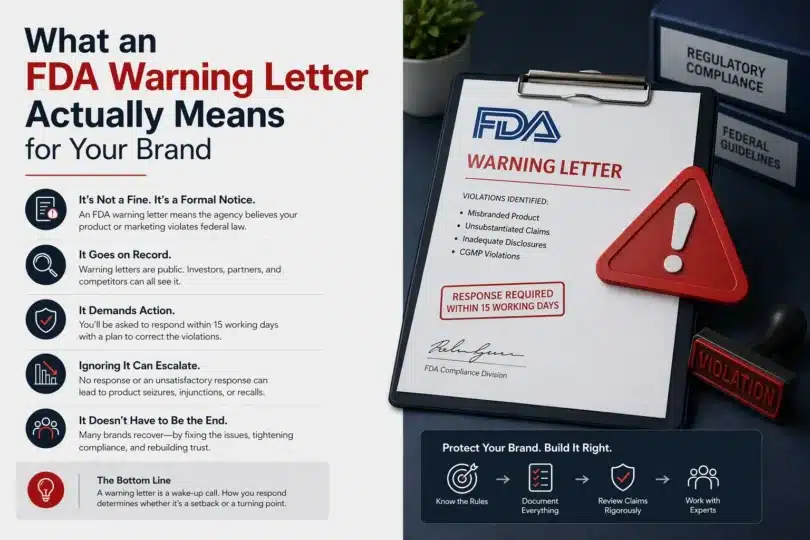

If your brand receives an FDA warning letter, the first thing most founders do is panic. The second thing they do is check with ChatGPT, Claud, Gemini or Grok. Eventually, most realize they should also call a lawyer. Both reactions are understandable. But before either response is useful, it helps to understand exactly what a warning letter is, what it isn’t, and what the FDA actually expects you to do about it.
Most brands in regulated wellness have heard of FDA warning letters without fully understanding the mechanics behind them. That’s a problem, because misunderstanding what a warning letter means leads to either overreaction (costly legal responses to issues that could be resolved with a simple website edit) or underreaction, which is even worse.
Some even decide to ‘solve the problem’ by avoiding using any problem/solution statement, which is the basis of your positioning, making your marketing significantly less effective.
So how do FDA warning letters work, what they typically cover in the wellness space, and what your response should look like.
What an FDA Warning Letter Actually Is
An FDA warning letter is an official communication from the FDA to a company or individual notifying them that the agency has found a significant violation of regulations it enforces. In the wellness space, warning letters most commonly relate to one of three things: structure/function claims that cross into drug claim territory, Current Good Manufacturing Practice (cGMP) violations, or adulterated or misbranded products (goods that violate government safety and labeling regulations).
A warning letter is not a fine. It is not a product recall order. It is not a criminal charge. It is the FDA telling you, formally and on the record, that something needs to change, and giving you an opportunity to fix it before the agency escalates.
The key phrase there is “on the record.” Warning letters are public documents. The FDA publishes them on its website, typically within days of sending them. This means a warning letter is not just a private communication between your company and the agency. It is a public signal to retailers, investors, media, and competitors about your compliance status.
The public dimension is often more immediately damaging than the letter itself. People see the warning letter as a proof of a violation and that they shouldn’t trust that brand. As a result, some retailers may review, suspend, or remove products while assessing the compliance risk.
In many cases, companies try to avoid the whole problem by killing the product, which is understandable, but also wrong in so many aspects.
Common Reasons Supplement Brands Receive an FDA Warning Letter
In the supplement category, the FDA’s warning letters usually cover one of three common issues below:
Prohibited drug claims. This is the most common trigger. Supplement brands are permitted to make structure/function claims, which are statements about how a nutrient affects the body’s normal structure or function. They are not permitted to make disease claims, which are statements that a product diagnoses, cures, treats, mitigates, or prevents a specific disease or condition.
The line between these two categories is where most brands get into trouble. “Supports healthy immune function” is a structure/function claim. “Treats cold and flu symptoms” is a disease claim. “Supports joint comfort” is a structure/function claim. “Reduces arthritis pain” is a disease claim. The line is real, enforced, and the FDA watches it closely, especially in CBD, botanical supplements, and any category that attracts health-conscious consumers with specific conditions.
cGMP violations. The FDA requires dietary supplement manufacturers to follow Current Good Manufacturing Practices, specific requirements around identity testing, manufacturing controls, record-keeping, and quality management. cGMP warning letters are less common than claim violations but tend to be more serious, because they signal systemic problems in how a product is made rather than how it’s marketed.
If this is the case for your brand, the solution is often more complex than correcting marketing language alone, as we will have to do more than to repair your messaging.
Adulteration and mislabeling. Products that contain undeclared ingredients, are contaminated, or fail to meet label claims can receive warning letters for adulteration. Products with incorrect labeling, missing required information, misleading serving sizes, or inaccurate ingredient declarations, receive mislabeling warnings.
What the FDA Expects After Sending a Warning Letter
The FDA’s standard expectation after issuing a warning letter is a written response within 15 working days. Your response should do three things: acknowledge the violations identified, describe the corrective actions you have taken or will take, and provide a timeline for completing those actions.
This is important: the FDA is not looking for an argument. It is not looking for an explanation of why your claims were reasonable. It is looking for evidence that you understand what the problem is and that you are fixing it.
The most effective responses are specific, concrete, and prompt.
“We have removed the claim from our website as of [date]” is better than “We are reviewing our website content.” “We have engaged a cGMP consultant and will complete a full facility audit by [date]” is better than “We take manufacturing quality seriously.”, etc.
Brands that respond poorly, or don’t respond at all, escalate the situation significantly. Non-response can lead to injunctions, seizures, or referral to the Department of Justice for criminal prosecution. These outcomes are rare but they do happen, and they almost always follow a pattern of ignoring or dismissing warning letters rather than addressing them.
And this is the right place to remind you that I am not a lawyer and that this is not legal advice… Please see the disclaimer at the bottom of this article.
The Claim Issue Specific to CBD and Botanical Brands
CBD brands and botanical supplement companies face a specific version of the drug claim problem that’s worth addressing directly.
The FDA has sent a significant number of warning letters to CBD companies specifically for disease claims — statements that CBD products treat anxiety disorders, cancer, Alzheimer’s disease, chronic pain, and other conditions. These claims appear frequently in brand copy, social media, customer testimonials, and FAQs. Each one is a potential warning letter trigger.
The challenge for CBD brands is that the research on CBD is genuinely promising for some of these conditions. Some clinical research suggests potential benefits of CBD for anxiety and certain pain-related conditions, although evidence varies by indication and product type. But “the research suggests” is not the same as “FDA-approved to treat.” Brands that only communicate what the research shows, without claiming therapeutic effect, or associating it to their products, are on safer ground than brands that use research findings as implied disease claims.
All that said, you should be very careful here, as a wrong choice of words could make the difference between safe or risky, and avoid crossing that line.
The practical rule: describe what CBD does in the body. Don’t describe what it does to a disease. “Supports a calm mood” is fine. “Reduces symptoms of anxiety disorder” is a drug claim. The distinction is real and enforced.
How a FDA Warning Letter Affects Your Brand
As noted earlier, warning letters are public. Here is what that means practically for a supplement brand:
Major retailers, particularly natural-channel retailers, monitor FDA warning letters actively. Receiving a warning letter can trigger a review of your shelf placement, a pause on new product submissions, or in serious cases, removal from shelves. The speed and severity of the retailer response depends heavily on the nature of the violation and how publicly visible the warning letter becomes.
Amazon has removed products and sellers following compliance concerns, including issues highlighted by FDA enforcement actions, particularly in the CBD and botanical supplement categories.
Investors and acquirers conduct compliance due diligence that includes reviewing warning letter history. A warning letter doesn’t necessarily kill a deal, but an unresolved warning letter or a pattern of violations will raise serious concerns about the quality of your compliance infrastructure.
Media coverage of warning letters in the supplement space tends to be sensationalized. A warning letter for a minor claim violation can generate coverage that implies far more serious issues than the letter actually represents. Having a clear, accurate statement about the violation and your corrective response ready before media inquiries arrive is worth the preparation. Ignoring an FDA warning letter could raise unwanted attention.
What to Do if You Receive One
The practical steps in order:
First, read the letter carefully and identify every specific violation cited. Warning letters are precise documents. The FDA tells you exactly what it found objectionable and where. Make a list and act upon.
Second, remove or correct the violating content immediately. Don’t wait for a reminder before taking your website claims down. Speed of response matters and the FDA notes it.
Third, engage legal counsel with FDA regulatory experience, not general business counsel. The regulatory framework around dietary supplements is specialized and the nuances of claim language matter significantly in your response.
Fourth, draft your written response within the 15-working-day window. Be specific, be concrete, and provide dates.
Fifth, review your entire claim architecture – website, packaging, social media, email, and advertising that share the same problem. A warning letter for one violation often reveals a pattern. Fixing the cited violation while leaving similar violations in place is a short-term solution that creates a longer-term problem.
Finally, use the warning letter as an audit trigger. If the FDA found something worth a formal letter, there are almost certainly other compliance issues in your marketing and manufacturing that haven’t been flagged yet. A voluntary compliance review is significantly less expensive than a second warning letter.
A Warning Letter Is Not the End
Receiving a warning letter is never pleasant. The public nature of the process, the legal implications, and the potential impact on retailers, partners, and investors all require time and resources to address.
At the same time, a warning letter is not a recall, a lawsuit, or the end of a business. The FDA issues warning letters across many regulated industries, and numerous supplement, CBD, and wellness brands have received them and continued to operate successfully. What often separates the brands that recover quickly from those that struggle is the speed of their response and their willingness to take compliance seriously.
A warning letter is ultimately the FDA identifying a problem and giving you an opportunity to correct it. The companies that view it as a compliance audit rather than a public relations crisis are often the ones that emerge with stronger systems, clearer processes, and more credible positioning.
The better approach is not to wait for a warning letter at all. Regularly reviewing your claims, marketing materials, product labeling, website content, and customer-facing communications can help identify potential issues before regulators do. In most cases, prevention is significantly less expensive than remediation.
If you operate in CBD, supplements, functional mushrooms, pet health, or other regulated wellness categories, building a compliance review process into your business is one of the most valuable investments you can make. Strong positioning and effective marketing are not achieved by pushing closer to the regulatory line. They are achieved by communicating clearly, credibly, and responsibly while remaining compliant.
Disclaimer: This article is provided for educational purposes only and does not constitute legal advice. If your company receives an FDA warning letter, consult an attorney or regulatory professional with experience in FDA compliance and dietary supplement regulations.
Test – wp engine



Have anything to add? Your voice matters! Join the conversation and contribute your insights and ideas below.