



Regulated wellness growth has a pattern. You build something real, generate early revenue, try the usual things: more content, better ads, a new agency, a redesigned website. And yet you keep hitting the same ceiling, quarter after quarter.
Here’s the uncomfortable truth: you’re probably solving the wrong problem.
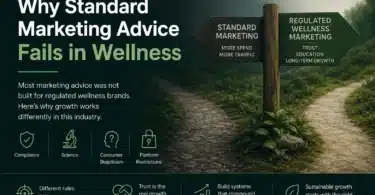
Most brands that hit the regulated wellness growth wall blame their marketing. Not enough traffic. Wrong channels. Bad creative. So they spend more on the same approaches, get the same results, and conclude that their market is just hard.
The market is hard. But that’s not why you’re stuck.
The Real Problem With Regulated Wellness Growth Isn’t Your Marketing
After eight years of working inside regulated wellness markets, supplements, CBD, cannabis, pet health, functional wellness, I’ve seen the same pattern repeat across dozens of brands.
The regulated wellness growth problem almost never starts in marketing.
It starts in positioning. It starts in how the brand has defined itself, relative to its market, its buyer, and its regulatory environment. By the time you see it in your conversion rates and acquisition costs, it’s been sitting in your messaging and channel mix for months. Sometimes years.
By that time it’s becoming harder and harder to undo the damage. In-fact, when positioning is wrong, more marketing spend doesn’t fix a problem. It amplifies it.
What the Regulated Wellness Growth Wall Actually Looks Like
The regulated wellness growth wall tends to show up in one of three ways.
Traffic without conversion. You’re getting visitors. They’re not buying. You’ve optimised the product page, tested the copy, improved the checkout flow. Nothing moves. You only later realize that the problem isn’t the page, it’s that the visitor arrived with the wrong expectation. This false image of your products is the result of your positioning and this is where you should focus your attention.
Conversion without retention. First-time buyers don’t come back. You’re on a constant treadmill of acquisition spend just to maintain flat revenue. In regulated wellness, unless the product itself is of poor quality, this almost always traces back to a messaging problem. The product was sold on a promise that the product itself can’t legally make explicit, so the buyer doesn’t build the habit or the trust that drives repeat purchase.
Using marketing tactics to get new clients, such as coupons, sales, price reduction, etc. just make the problem worse (unless you know how to balance its effects with bundling, but that’s for another article).
Growth that stops at a ceiling. Revenue grows steadily to a point, $100K, $300K, $500K, $1M, and then plateaus. The brand has found its natural audience within its current positioning and exhausted it. Breaking through requires repositioning, not more marketing into the same audience.
Many brands try to break that loop, by promoting their existing products to new audiences. However, they fail to understand, that each new audience needs more than a new LP. It needs a new story to make sure that specific product fully answers the new audience’s pain. And it doesn’t end here, as a new market needs many time, a fully integrated market education campaign, to make sure the markets are waiting for your products, even before you start selling.
Each of these looks like a pure marketing problem. The reality, however, is much more complicated than that.
Why Regulated Markets Make This Harder
In an unregulated market, you can say whatever you want to say and do what’s needed in order to convert. You can make the claim, run the ad, tell the story that closes the sale.
In regulated wellness, you can’t and you shouldn’t as this will put your brand in danger. Do that and expect to get a warning letter from the FDA or the FTC, which is the end of the road for you. And so brands adapt, not by understanding the hidden benefits of compliance in wellness, but by saying less, hedging more, and hoping the product speaks for itself.
It doesn’t. Not because the product isn’t good (which sadly might also be the case as many poor-quality products have entered the market recently), but because the buyer in this market is trained to be skeptical. They’ve been burned before. They’re not waiting to be impressed, they’re waiting to be disappointed.
The messaging gap that compliance creates has to be filled with something else. Specificity. Transparency. The signal that you understand your market, your product, and your regulation better than anyone else selling in your category.
Most brands don’t fill that gap. They leave it empty and wonder why trust is so hard to build.
The Three Questions Worth Asking
If growth has stalled, the diagnosis usually starts with three questions.
Who is your target audience? Not the general category, the specific buyer. Their level of sophistication, their prior experience with products like yours, their skepticism profile, their demographics, etc. The more precisely you can answer this, the more precisely your messaging can speak to them. Vague positioning attracts vague buyers who don’t stick.
What you can actually prove? In regulated wellness, the gap between what you want to claim and what you can claim is where most brands lose the conversion. The answer isn’t to close that gap illegally. It’s to find the thing you can prove: third-party testing, published research, transparent supply chain, customer outcome data, and make that the center of your messaging.
Are you in the right channels for this buyer? A supplement brand targeting health-conscious 40-somethings and a CBD brand targeting chronic pain sufferers are not in the same channels, even if they’re both “wellness.” The channel has to be tailored to your target audience and hit them when they’re ready to trust a new brand. Getting this wrong means spending money on audiences who will never convert, regardless of how good the creative is, or even worse, buy once and never return.
What Fixing The Regulated Wellness Growth Actually Requires
I’ll be honest, some of what you’ve already spent on marketing may not return. But the fix itself doesn’t have to be complicated. It doesn’t require rebuilding your product or abandoning what you’ve built. It requires stepping back from the tactics and asking whether the foundation they’re built on is solid.
Are you talking to the right target audience? Is your positioning specific enough to mean something to your buyer audience? Is your messaging taking advantage of the regulatory environment, or trying to avoid it? Are your channels matched to how your actual buyer makes decisions? etc.
Most of the time, the answers reveal one or two main problems that, once addressed, changes your growth potential. The ceiling lifts, not because the market got easier, but because you have adapted to the industry you are operating in.
Nothing less is required of you.



Have anything to add? Your voice matters! Join the conversation and contribute your insights and ideas below.