


Pets cannot tell us exactly what is wrong, so identifying a health concern can be difficult. A dog owner may notice a recurring problem: itching that keeps returning, stiffness after a walk or digestion that never seems completely settled. The owner wants to help, but without guidance from a veterinarian, pet-supplement websites may introduce even more questions. What could be causing the problem? Which product, if any, is appropriate? Which ingredients matter? Which company offers thoughtful guidance rather than simply filling a catalog?
Today, we will examine two leading pet-health brands and ask: which pet-supplement homepage makes the choice easier?
PetLabCo and Finn are two established pet-health brands. Both present polished product ranges and substantial veterinary credibility. But can they give a worried pet owner enough information to decide, within seconds, which homepage is easier to trust and navigate? Which brand makes the decision easier and the next step feel natural? Let’s look more closely.
Both homepages present substantial evidence and performed well in our Homepage IQ test, with scores above 70. PetLabCo brings named experts, clinical studies, substantial review volume and category certification. Finn presents several named veterinarians and pairs professional authority with customer stories tied to recognizable outcomes.
Our Homepage IQ assessment also found that PetLabCo led in Offer Clarity, Audience Fit and Credibility, while Finn made the next action clearer. As we have seen many times before, the order of information matters. A simpler path is not always the strongest one if the most persuasive evidence appears only after the visitor has been asked to buy.
For a pet owner seeking a remedy rather than another shopping task, the stronger homepage must establish trust and make the next sensible step feel obvious. Without that flow, a homepage may lose qualified visitors before they encounter its most persuasive evidence.
Let’s examine the two homepages more closely.
PetLabCo builds an unusually dense trust case
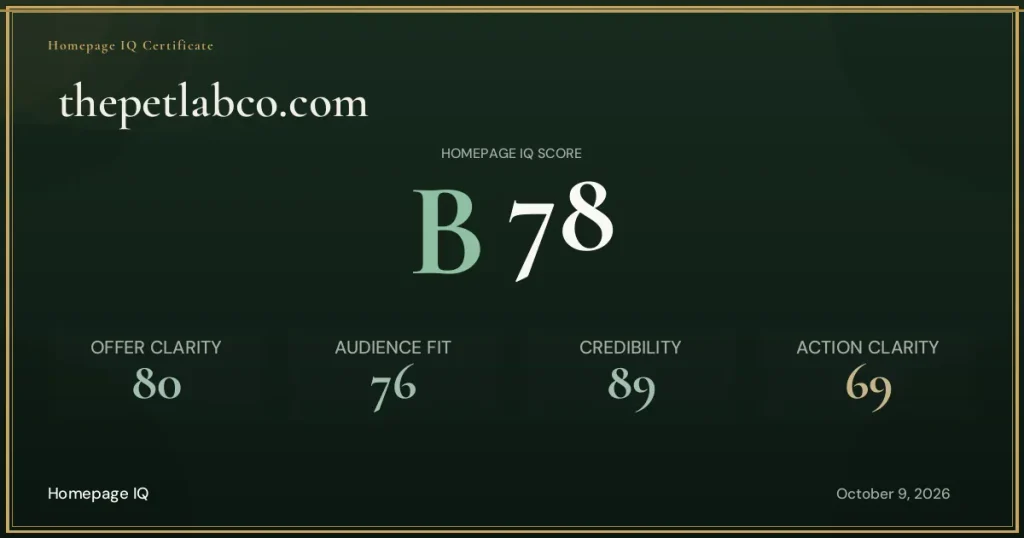
PetLabCo’s evidence base is difficult to ignore. Named veterinary experts, multiple clinical studies, more than 100,000 reviews across platforms, NASC certification and an industry award create several independent reasons to believe the company is serious.
The homepage also frames the problem clearly with language about taking the guesswork out of dog health. That is a strong customer insight. Pet owners often face too many products, too many claims and too little certainty.
PetLabCo’s Homepage IQ report summarizes the homepage’s main problem well:
“CTA architecture is fragmented across quiz, shop-all, individual products and app download, with no clear hierarchy. The page’s deepest credibility content, including clinical-study details and expert credentials, is buried in FAQ blocks that require significant scrolling to reach. This means many visitors may leave before encountering the brand’s strongest proof.”

The irony is that the page already has all the necessary parts. What is missing is a clear order for what visitors should do first. In short, the hierarchy is not always obvious. If the brand says it simplifies dog health, the first action should feel equally simple.
A company cannot credibly claim to remove guesswork while asking new visitors to choose among several equally prominent starting points. The quiz could perform that role if the page makes clear why its recommendations deserve trust and who should use it. Alternatively, a need-based route could help owners begin with the symptom or concern they already understand. What matters is that the interface demonstrates the promise.
This is a relatively minor change to an already well-performing homepage, but it could make the customer journey clearer and support better commercial results over time.
Finn makes the page feel human
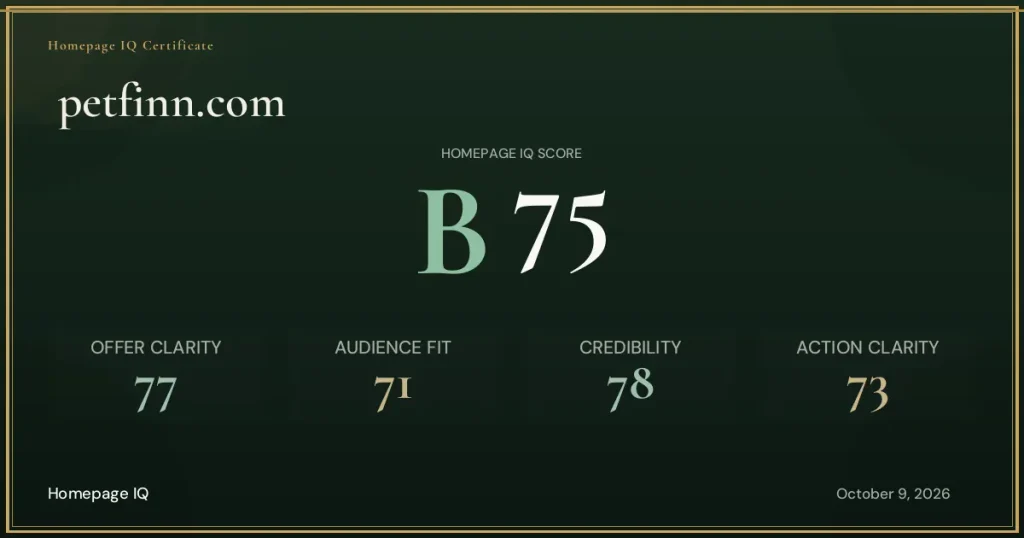
Finn combines named veterinarians with outcome-specific customer testimonials. That pairing is useful because experts and customers answer different questions.
The veterinarians help validate the formulations and the seriousness of the company’s approach. The customer stories help the buyer imagine what improvement could look like in everyday life. Together, they create a trust structure that feels more human than a collection of badges.
Finn’s Homepage IQ report summarizes the homepage’s main problem well:
“The hero section leads with emotional warmth rather than the brand’s strongest credentials, and trust-building evidence is sequenced after the purchase ask. This means first-time visitors encounter the ‘why buy’ argument only after they have already been asked to shop.”

Finn’s limitation is timing. Emotional warmth appears early, while some of the stronger professional proof arrives after the visitor has already been asked to shop. A warm brand can attract attention, but first-time buyers may still need evidence before they are ready to act.
Finn should bring one precise veterinary signal closer to the opening without losing its approachable tone. The point is not to make the page clinical. It is to let warmth and authority reinforce each other from the beginning.
The customer stories can then do more than create emotion. Positioned after a clear professional standard, they show what that standard looks like in ordinary life. A veterinarian explains why the formulation deserves consideration; an owner shows why the result matters. This sequence can make the brand feel both responsible and relatable without forcing either type of evidence to carry the entire trust case.
More proof does not automatically make the choice easier
PetLabCo makes the stronger overall homepage case. Its evidence base is difficult to ignore, and it leads the comparison in several important dimensions. Finn, however, makes the experience somewhat easier to act on and shows how warmth can reduce the distance between professional authority and the pet owner.
Return to the person worried about itching, stiffness or digestion. They do not want to become an expert in every ingredient before helping their dog. They want the company to turn its expertise into a credible route.
PetLabCo can strengthen its lead by using its dense proof to remove choices rather than adding more of them. Finn can close the gap by bringing its veterinarians and outcome stories forward so that its approachable path feels grounded from the beginning.
Neither brand needs another trust signal. The next advantage will come from making its existing expertise useful at the moment uncertainty is highest.
That moment usually arrives before the owner knows the product name. The person knows that the dog is scratching, moving differently or experiencing digestive trouble. A homepage organized primarily around formats or branded formulations asks the customer to translate the problem into the company’s internal catalog. A homepage organized around the customer’s question performs that translation for them.
The long-term opportunity is larger than the first sale. When a brand demonstrates a repeatable way of guiding owners from a concern to a credible next step, it can become the place they return to when a different need appears. Guidance then becomes a brand asset, not merely a conversion device attached to one product.
A brand can test a clearer hierarchy without displaying every recommendation at once. However, deciding which proof to prioritize requires competitive context.
Want to know where your homepage creates unnecessary choices compared with five named competitors? The Homepage Intelligence Report shows which proof is genuinely distinctive and what should be tested first.

Strategy tip: Turn authority into a simpler buying path
Map the main reasons visitors arrive. Separate people who know the exact product from those who know only the problem and those who are still deciding whether to trust the company.
Choose one primary route for first-time, problem-aware visitors. Give returning or product-aware customers a faster secondary route without making the two actions compete equally.
Place one expert proof point beside the primary route. If a quiz is the main action, explain who shaped its recommendations. If a product category is the main action, show why the formulation standard deserves trust.
Use the middle of the page to expand the evidence. Then measure whether the hierarchy reduces wandering and increases movement into need-specific collections or relevant product pages.
Use an analytics platform to measure the results, and use a First Impression Optimization tool such as Homepage IQ to identify whether your homepage helps visitors choose or merely gives them more information to process.
Method note: This independent comparison reflects the brands’ public homepages as assessed in October 2026. It evaluates homepage communication, not product quality, company performance or customer outcomes.




Have anything to add? Your voice matters! Join the conversation and contribute your insights and ideas below.