


Imagine someone looking for a solution because insomnia or restless nights, everyday discomfort, or persistent stress have become difficult to ignore. The person is not searching for a lesson in extraction methods. They want an option that feels appropriate, dependable and trustworthy enough to try. CBD belongs to that category. In this article, I compare the homepages of two leading CBD brands.
The search for a CBD product quickly produces several established alternatives, including Joy Organics and Cornbread Hemp, the two brands whose homepages I am comparing today. Their products can look similar at first. Both companies make extensive quality claims, present reassuring policies and display substantial customer approval. A visitor may give each homepage only a few seconds before deciding which brand deserves closer attention.
Those seconds matter, and the buyer’s decision may be influenced heavily by their first impression of the homepage. Joy Organics presents named medical advisors, extensive batch checks, thousands of reviews and a long guarantee. Cornbread Hemp brings a medical advisory board, USDA Organic certification, substantial review volume, a clear extraction story and its own guarantee. Both can establish trust, but only if the homepage helps the buyer understand why the evidence matters to the problem they are trying to solve.
Our research produced several interesting findings, including that both brands recognize trust as a primary goal. As a result, both received strong Homepage IQ credibility scores. This is smart because credibility is particularly important in this category, but it also creates a challenge: how can each brand establish a more personal customer connection, and which homepage can turn proof into confidence before the visitor moves to another alternative?
Before diving into the details, let’s start with the bottom line. Both brands present strong homepages and earned similar overall scores. However, our Homepage IQ comparison found that Cornbread Hemp held a slight advantage, mainly because of how it approaches credibility, making it the winner of this matchup.
Joy Organics makes quality feel organized
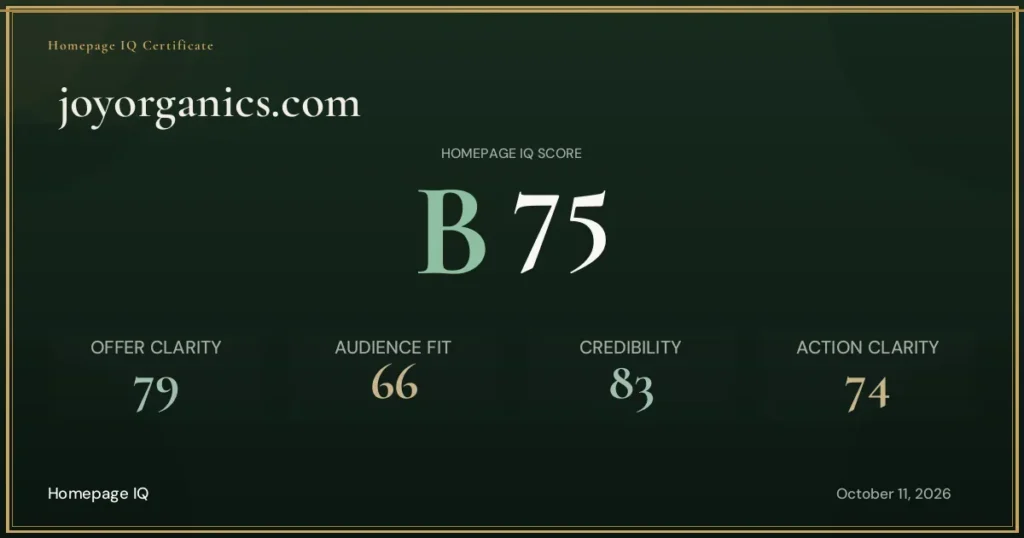
Joy Organics communicates a controlled, careful brand. Its quality argument is not built around one badge. It is assembled from several reinforcing signals: credentialed advisors, testing, accessible lab information, customer reviews and a generous guarantee.
That matters in CBD because visitors are rarely evaluating only the promised benefit. They are also asking whether the product is safe, whether the company is legitimate and whether they will regret trying it. Joy Organics has material that can answer those questions.
Its challenge is breadth. The homepage speaks to many needs and many types of shoppers. Sleep, calm, activity, pets and other use cases all have commercial value, but together they can make the opening feel like a catalog of possibilities instead of a recommendation for a particular person. This may be a reasonable commercial choice, but the tradeoff appears in the Audience Fit score. Visitors may find it harder to recognize themselves in the message and understand which products are intended for people like them.
The action for Joy Organics is not to remove that range. It is to create a clearer first route through it. A visitor should quickly recognize either the person the page is for or the problem the page helps solve. The proof can then support that path instead of sitting beside several competing paths.
That distinction matters for a brand with many legitimate audiences. Trying to name every possible need in the opening can make the page accurate but indecisive. A stronger sequence would let the visitor recognize one important situation first, then discover the broader range after confidence has begun to form. The homepage would still serve several customer groups without asking all of them to interpret the entire portfolio at once.
Cornbread Hemp makes trust feel substantial
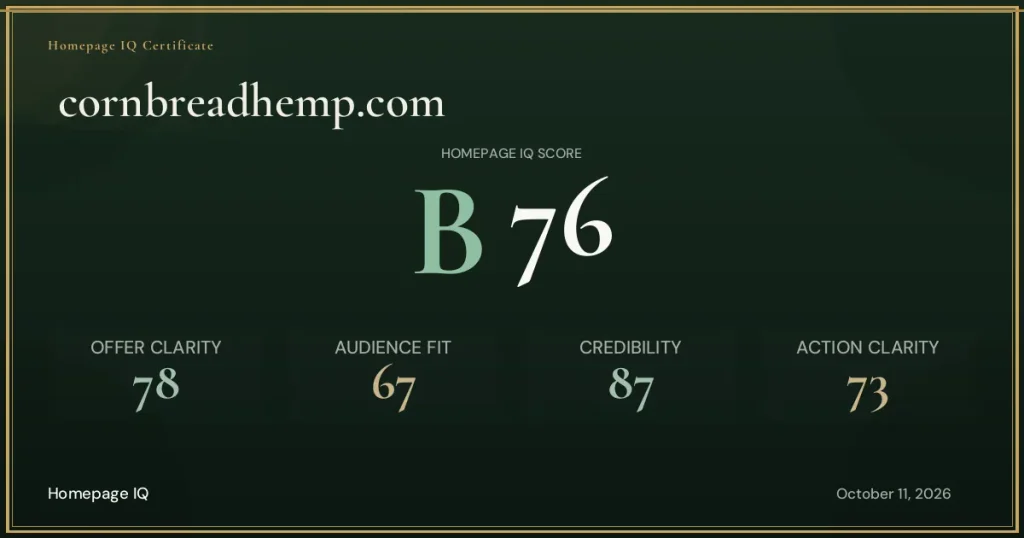
Cornbread Hemp also has a strong proof base, but its assets create a slightly different impression. The combination of organic certification, a named advisory board, product-process language and review volume makes the brand feel established and difficult to dismiss.
Its “Farm to Feel Good” direction gives the homepage warmth. It avoids sounding like a laboratory catalog, which is useful in a category where scientific language can become cold or interchangeable.
The tradeoff is that warmth can become broad. A phrase such as “feel good” invites many people in, but it does not tell one high-intent buyer why this product fits their situation better than another respected CBD brand. Cornbread Hemp has plenty of evidence, yet some of its strongest evidence appears after the visitor has already been asked to shop.
The action for Cornbread Hemp is to move one or two decisive trust signals closer to the first promise. The opening does not need the entire proof stack. It needs enough evidence to turn a friendly promise into a credible choice. This change should be A/B tested because it may trade some immediate clicks for stronger understanding among first-time shoppers.
The company should also make the relationship between “organic” and the buyer’s concern explicit. Certification is important, but a new customer may not automatically know what conclusion to draw from it. The page can connect that standard to the reassurance the visitor is seeking, then allow deeper content to explain the process. This is how a badge becomes part of the decision rather than simply decorating the page.
I am deliberately excluding the temporary “The Clock Is Still Ticking: The Fight to Save Non-Synthetic Hemp Is Not Over” message from the comparison. This is not because it is unimportant. It is important, and it can add trust. I also like how Cornbread Hemp presents the issue because it positions the company as a category leader. However, it is a temporary campaign rather than a permanent part of the homepage argument.
Which homepage makes the stronger case?
Cornbread Hemp held the slight overall advantage in this assessment, supported by a particularly strong credibility case. Joy Organics, however, presents an unusually organized quality story. The difference is not large enough to suggest that one company needs more proof while the other does not. A First Impression Optimization tool such as Homepage IQ could help both brands identify how these differences affect new visitors and improve the way each brand approaches first-time customers.
The decision is shaped by sequence. A persuasive CBD homepage needs to help a visitor answer four questions: Is this for someone like me? What can it help me do? Why should I believe this brand? What should I do next?
Both brands answer the credibility question well. Their larger opportunity is to make the intended customer and outcome more specific before presenting several products and paths. This is where many CBD brands partly fail, and it is where these companies could win more future customers.
Return to the person looking for help with sleep, discomfort or stress. They do not need Joy Organics to prove that Cornbread Hemp is untrustworthy, or the reverse. They need one homepage to make the choice feel safer and more personally relevant within a few seconds.
Based on the homepage snapshots assessed on October 11, Cornbread Hemp currently makes the slightly stronger overall case. Joy Organics can close that distance by connecting its controlled quality system to a clearer person and problem. Cornbread Hemp can strengthen its lead by making its substantial proof useful earlier in the decision.
Neither brand needs a louder homepage. For most CBD companies, greater volume is not the answer, although brands built primarily around THCA or Delta-9 THC may face a different commercial challenge. In the CBD space, the winner will design a homepage that turns evidence into guidance before the visitor continues comparing alternatives.
Want to see how your homepage compares with five named competitors? The Homepage Intelligence Report identifies where your brand leads, where competitors make the stronger case and what you should test first.
Explore the Homepage Intelligence Report.

Strategy tip: Make proof carry the buyer toward a decision
Start by choosing the most important first-time visitor, not the entire customer base. Give that person one need-based or product-based route that reflects the reason they arrived.
Place one specific proof point beside the promise. A certification, named expert or testing standard can support the opening without turning it into a wall of badges. Deeper sections can carry the full body of evidence.
Review the homepage. Can a new visitor identify who the page is for, understand the core promise and see one sensible next step? If further explanation is required, the product catalog is probably doing work that belongs to positioning rather than sales. In plain English, visitors are reaching product choices before they fully understand their needs and the company’s solutions. This may reduce conversion rates.
Finally, continue optimizing and measuring. Do not use click as the only goal. Track whether qualified visitors move into the product, educational or guidance path that matches the need introduced at the beginning.
Again, you can use a First Impression Optimization assessment tool such as Homepage IQ to identify where the promise, proof or next step loses clarity before you begin testing changes.
Method note: This independent comparison reflects the brands’ public homepages as assessed in October 2026. It evaluates homepage communication, not product quality, company performance or customer outcomes.




Have anything to add? Your voice matters! Join the conversation and contribute your insights and ideas below.