
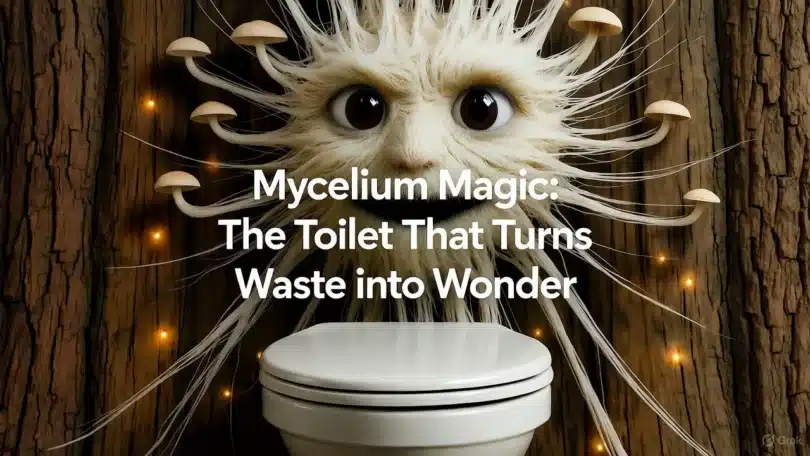


What if the solution to sanitation came not from chemicals or plumbing—but from fungi? Researchers at the University of British Columbia (UBC) have unveiled the MycoToilet, the first waterless, mushroom powered toilet that uses mycelium – the underground network of fungi – to break down human waste, neutralize odors, and produce compost.
In a world where more than half the population lacks safe sanitation, the MycoToilet offers a radical alternative. It’s simple, elegant, and alive. Unlike conventional systems that consume water and energy, this one transforms waste into usable soil nutrients—while leaving behind almost no smell.
Now being piloted at the UBC Botanical Garden, this experimental toilet could signal a new era for eco-sanitation and circular design.
The MycoToilet: The first Mushroom Powered Toilet
At first glance, the MycoToilet looks like a minimalist wooden outhouse. But beneath its cedar walls lies a living machine.
The system separates liquids and solids. The solids enter a compartment lined with mycelium, a dense web of fungal roots. Mycelium is nature’s decomposer—it digests organic material while filtering harmful microbes and neutralizing odors.
As waste enters the chamber, the fungi’s enzymes begin breaking down cellulose, fats, and proteins. The structure allows airflow, enabling aerobic decomposition (which avoids methane buildup). Sensors track moisture and temperature to maintain the right conditions.
Unlike typical composting toilets, this design is odor-free. Mycelium binds odor compounds like ammonia and hydrogen sulfide, eliminating more than 90% of the smell.
It’s a closed-loop system: solids become compost, liquids are filtered into nutrient-rich water suitable for irrigation or fertilizer.
Each unit can produce roughly 159 gallons of compost and 528 gallons of liquid fertilizer a year.

Why Mushrooms?
Mycelium isn’t just a decomposer—it’s a biological engineer. It forms vast underground networks that recycle organic matter and even communicate chemical signals between plants.
Scientists have already used fungi to make building materials, leather substitutes, and biodegradable packaging. The MycoToilet applies that same circular principle to human waste.
“Fungi are masters of transformation,” said Dr. Claire Hughes, a sustainability engineer at UBC. “We realized they could handle the dirtiest job on Earth—with elegance.”
Mycelium’s ability to capture and digest waste without producing toxic residues could make it a cornerstone of next-generation sanitation. It’s alive, regenerative, and endlessly renewable.
Environmental and Social Benefits
Traditional toilets rely on vast infrastructure: pipes, water, treatment plants. In developing regions—or remote areas—that infrastructure simply doesn’t exist.
The MycoToilet needs none of it. It can operate off-grid, with only a small solar-powered fan and periodic maintenance. That makes it ideal for rural communities, parks, refugee camps, and festivals.
It also dramatically reduces water consumption. A typical flush uses six liters of drinking water; the MycoToilet uses zero.
In global terms, if even 1% of the world’s population switched to waterless toilets, billions of liters of clean water could be saved daily.
It’s not just environmental—it’s philosophical. It reframes waste as a resource, not a problem.
Challenges Ahead
While the technology works, the biggest barrier may be psychological. Most people aren’t ready to trust fungi with their bathroom duties. Cultural norms, sanitation laws, and public health codes will need to evolve.
Regulators must ensure that composted waste is pathogen-free and safe for use in agriculture. There’s also the challenge of cost: early prototypes are expensive, though prices should drop with scaling.
But every major innovation in sanitation—from indoor plumbing to dry toilets—started as a radical idea. The MycoToilet may be next in line.
Mushroom Powered Toilet – Conclusion
The MycoToilet represents more than a clever invention—it’s a quiet revolution in how we see biology. Instead of fighting nature, it partners with it. Instead of using chemicals to mask waste, it invites fungi to transform it.
At a time when the planet struggles with pollution and resource scarcity, a living, breathing mushroom powered toilet might be one of the most hopeful ideas yet. Because in nature, there is no “waste.” Only transformation.
Source: UBC news


Have anything to add? Your voice matters! Join the conversation and contribute your insights and ideas below.