
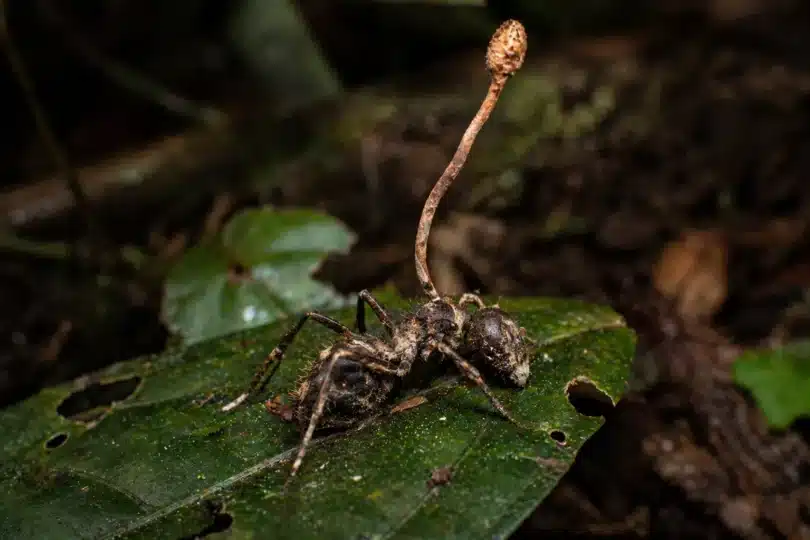


Cordyceps is a popular functional mushroom, usually discussed in the context of energy, immunity, and wellness products. Most people encounter it through capsules, powders, or blends marketed for daily performance. But the origin story of cordyceps is very different. It involves ants, behavioral control, and something that resembles a scene from a horror movie. Let’s take a closer look at the origin of the so-called “zombie-ant fungus.”
In nature, certain species of cordyceps infect insects, alter their behavior, and use their bodies to reproduce. This is where the term “zombie-ant fungus” comes from. It sounds extreme, and it is, but it is also well documented.
Understanding this process gives a clearer picture of what cordyceps actually is, how it evolved, and why it behaves the way it does.
What Is the “Zombie-Ant Fungus”?
The term refers to species within the Ophiocordyceps genus, closely related to cordyceps fungi. One of the most studied species is Ophiocordyceps unilateralis. These fungi are known to infect ants in tropical forests, particularly carpenter ants. Once inside the host, the fungus begins to grow and interact with the insect’s internal systems.
Over time, it alters the ant’s behavior in a very specific way.
How the Zombie-Ant Fungus Infection Works
The process follows a structured pattern:
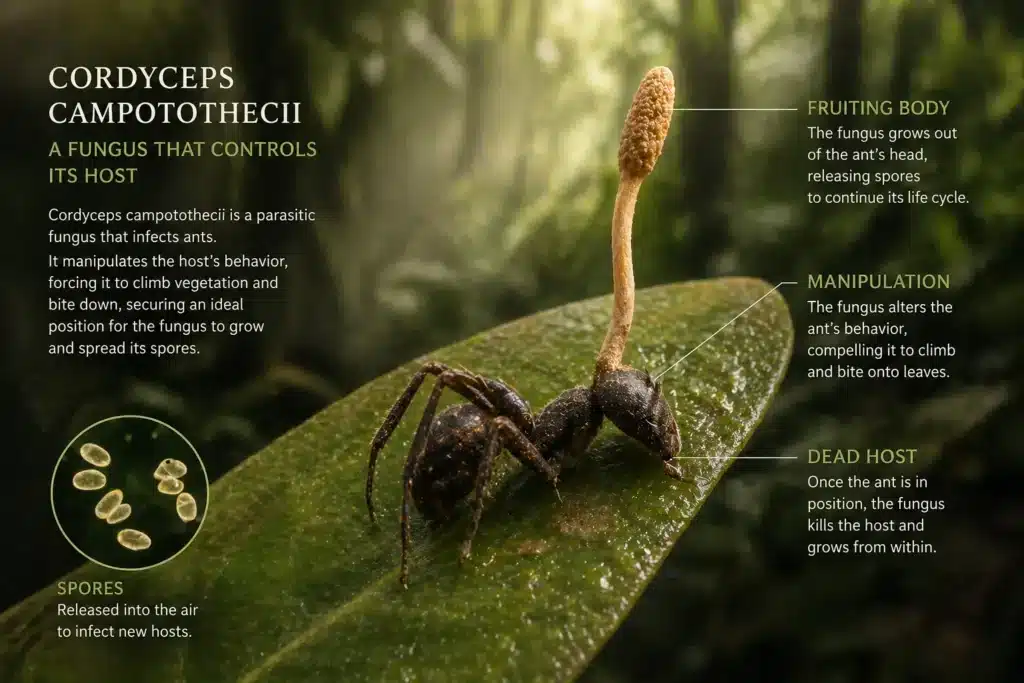
First, fungal spores attach to the ant’s body and penetrate its exoskeleton. Once inside, the fungus spreads through the body, forming a network that interacts with the host’s tissues. It does not immediately kill the ant, but continues to grow while the ant remains active.
At a certain stage, behavior changes begin. The ant leaves its colony and moves to a location that favors fungal growth. This is usually a humid environment with a stable temperature, often on the underside of a leaf above the ground. The ant then bites down and locks its jaw in place. This is often referred to as the “death grip.”
Shortly after, the ant dies.
From that position, the fungus grows a stalk from the body and releases spores, continuing the cycle.
What Controls the Ant’s Behavior?
One of the most important questions is how the fungus alters behavior. Early assumptions suggested that the fungus directly controlled the ant’s brain. More recent research indicates a more complex mechanism.
Studies show that the fungus forms a network around muscle fibers rather than invading the brain extensively. It appears to influence behavior through chemical signaling and movement control, rather than direct neural takeover.
In simple terms, the fungus may not “control the mind” in the way people imagine. It interferes with the body in a way that produces predictable behavior. This distinction matters because it shows how targeted and specialized the interaction is.
Why This Happens
From an evolutionary perspective, this behavior increases the fungus’s chances of survival and reproduction.
The elevated position of the ant allows spores to spread more effectively. The humidity and temperature of the chosen location support fungal growth.
Every step in the process improves the likelihood that the fungus will complete its lifecycle. This is not random. It is a refined biological strategy shaped over time.
How This Relates to Cordyceps Supplements
The cordyceps used in supplements are not the same species involved in the zombie-ant phenomenon. Most commercial products use Cordyceps militaris, which can be cultivated in controlled environments.
The original Cordyceps sinensis also grows on insects in nature, but it is different from the Ophiocordyceps species that infect ants.
Still, the connection between these species matters.
It explains why cordyceps contains compounds designed to interact with biological systems. These fungi evolved to survive by influencing host organisms.
That does not mean they control human behavior, but it helps explain why they are biologically active.
From Parasitic Fungus to Wellness Ingredient
The transition from a parasitic organism to a wellness product is unusual.
Cordyceps moved from traditional use into modern supplements largely because of its perceived effects on energy and vitality. Research has identified compounds such as cordycepin and various polysaccharides that may influence cellular processes.
However, the strength of evidence in humans is still limited, and as in many other areas, the market is moving faster than the research. This does not mean that consuming cordyceps leads to effects similar to those seen in insects, but it does suggest that these fungi are biologically active and still not fully understood.
The Role of the Zombie-Ant Narrative in the Market
The zombie-ant narrative plays a significant role in how people perceive cordyceps.
For some, it creates curiosity and interest. For others, it creates hesitation. From a content perspective, it is one of the most powerful entry points into the topic. This article is a good example. It does not focus on positioning, retention, or typical business topics. However, it is likely to attract attention because the topic is unusual and memorable.
It captures attention in a way that typical supplement descriptions do not.
At the same time, it needs to be handled carefully. Overemphasizing the “zombie” aspect without context can distort understanding. Used correctly, it provides a strong educational hook.
It is important to be clear: the zombie-ant phenomenon does not imply that cordyceps supplements can alter human behavior in a similar way. The biological interactions in insects are highly specialized. They involve specific species, environments, and evolutionary adaptations.
Human physiology is fundamentally different.
Why This Matters for Understanding Cordyceps
The “zombie-ant” fungus is not a marketing invention. It is a real and well-studied biological process. Understanding it provides context for what cordyceps is and how it developed.
It is not just a generic mushroom. It is part of a group of organisms that evolved complex ways to interact with living systems. This helps explain why researchers are increasingly interested in its compounds and potential effects.
Will we see pharmaceutical drugs developed from cordyceps in the future? Perhaps, but until then, for now, it is best understood as a functional ingredient with growing interest rather than a fully established clinical compound.

Have anything to add? Your voice matters! Join the conversation and contribute your insights and ideas below.